Serveral types of primitive dogs have developed in different parts of the world. Here follows a list of the primitive dogs with their country of origin.
For more information about their history and origin, see our article about primitive and pariah dogs.
In different parts of the world these primitive dogs evolved into separate breeds, strains or types.
Africanis (Bantu Dog, South African Pariah Dog)
(South Africa - Natal area)
Described as looking like a cross between a greyhound and a Dingo. It is believed to descend from the dogs pictured on Egyptian murals, the earliest record of the domestic dog in Africa being from the Nile delta, dated 4700 BC. Today, Africanis is found all over the Southern African subcontinent. It is known by various names, in different languages.
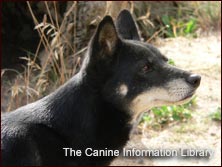
Untypical black dingo
Photo: Susan Flashman
Africanis, an african dog whose African heritage goes back 7000 years. Africanis is descended from the dogs pictured on Egyptian murals, the earliest record of the domestic dog in Africa being from the Nile delta.
Photo: Dion van Huyssteen
Actually, the Africanis is a Eurocentric (created) concept that is not recognized by indigenous peoples. The umbrella term 'Africanis' in fact includes various strains that are recognized as distinct types by traditional Africans. By throwing all of these unique types, like the Sicha, i-Twina, i-Nja iSintu, etc. under the umbrella of Africanis many of these traditional types are put at risk of losing their genetic uniqueness and will eventually disappear.
Aso: a native Philippine breed. Note that 'Aso' is also the Tagalog term for dog.
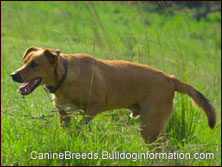
The coat color is typically yellow-ginger, but can occasionally be black, tan or white, with or without small white markings on the chest, muzzle and paws.
Basenji (Africa)
The Basenji, literally "little wild thing" is a spitz-type, fox terrier-sized dog with an astonishing sense of smell, sight and sound.
Canaan Dog (Israel):
A breed developed by Dr. Rudolphina Menzel, who started a breeding program to develop a working dog breed from local pariah dogs in Israel in the 1930's. More about the Canaan dog>>
Carolina Dog (S.E. United States)
Looking like a smaller version of the Australian Dingo, this ancient feral breed is still living wild in the remote lowland swamp and woodland areas of the southeastern United States. More about the Carolina dog...
Dingo of Thailand (Thailand):
Some authors believe the Thai Dingo is the purest form of dingo. It is often ginger-colored with white points to the ears and tail, but it can be black as well. It differs from the domestic dog in that the Dingo breeds only once a year and it seldom barks.
Indian Pariah Dog (India)
The term 'pariah dog' is sometimes still used to refer to any type of feral dog or primitive dog. However, the Indian Pariah Dog is a specific, ancient breed related to the Bali feral dog and the Australian Dingo. Indian Pariah dogs are friendly, smart and highly adaptable. They are usually healthy and sturdy, and particularly hardy, especially in tropical climates.
Indian Santal Dog (also known as Santal Hound) (India)
Like the New Guinea Singing Dog and Dingo of Australia, belonging to the so-called Indo-Polynesian Group.
Khoi Dog (South Africa - Cape Area)
Khoi dogs are primarily hunting dogs, but they are also used to protect herds against predators such as jackals, lions and hyenas. They are fox-like in appearance with erect ears. The Khoi dog does not bark, but howls much like the Basenji. Another peculiarity is that the breed has developed a natural immunity against the Sleeping Sickness transmitted by the Tse tse fly, which affects most domestic animals and livestock in its native region.
New Guinea Singing Dog
Unfortunately, this breed being on the verge of extinction, the New Guinea Singing Dog's taxonomic status in not very clear.
They were long considered a unique species, canis hallstromi. Then, in 1969 they were grouped with the Australian Dingo as a feral wild (wild-living) subspecies of the domestic dog. As a result they were no longer protected by wildlife enthusiasts and traditional conservation organizations, but remained too wild a canid to develop as a popular pet dog. Most zoos also stopped breeding them, and their captive population has subsequently declined.
The New Guinea Singing Dog Conservation Society, a not-for-profit organization to promote NGSD conservation both in the wild and in captivity, funds non-invasive research on NGSDs and promotes the breeding of documented NGSDs. They encourages NGSD owners to participate in research by donating NGSD blood and other samples for DNA analysis and sharing medical information.
Telomian (Malaysia)
The Telomians carry many similarities to the Basenji and other pariah dogs: light square body structure, annual estrus cycle, and typical howling. They take their name from the Telom River in the jungles of Malaysia, their natural habitat. Because of their geographical origin, they are sometimes considered the 'missing link' between the African Basenji and the Australian Dingo.
The Australian Native dog, also known as Warrigal, is usually yellow-ginger in color and, unlike wolves and other canids, rarely hunts in packs. It is still often considered as vermin and lacks protection in many parts of the world. The formal recognition and use of studbooks and registries therefore is a way to ensure protection of these genetically unique strains of primitive dogs against extermination or assimilation within other populations of stray or pure-bred dogs.